Speak up for starving Ospreys
Help us advocate for a reduced cap on menhaden. Public comment is accepted until Oct. 9.
The Connecticut Audubon Society is asking our members and supporters to help us advocate for Ospreys during an important public comment period that ends on Oct. 9.
The Atlantic States Marine Fisheries Commission is seeking input as it considers changes to the amount of menhaden that can be commercially harvested from the Chesapeake Bay.
Connecticut Audubon is urging the commission to reduce the fishery cap by 50 percent, a precautionary measure to ensure that menhaden, a key foundation fish and a prime food source for Connecticut’s Osprey, are not put in even greater jeopardy.
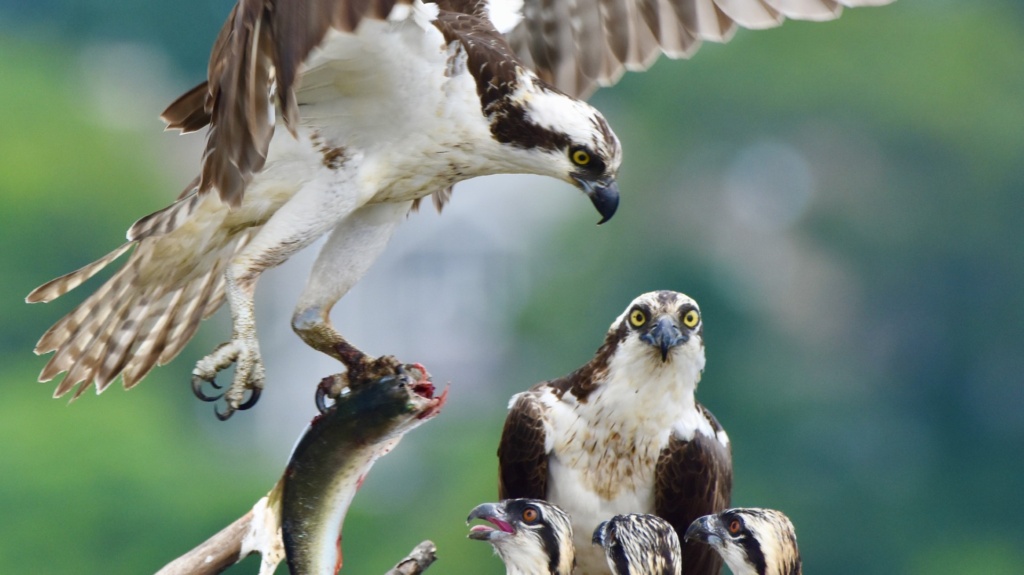
Photo by Gilles Carter
There is growing concern that Osprey populations along the Eastern seaboard are declining due to a lack of food. Last year, Connecticut Audubon’s Osprey Nation recorded its lowest breeding success since the statewide community science program launched in 2014 to monitor the birds.
This year is looking even worse.
“For the first time, we’re seeing the majority of nests either fail or produce just a single chick,” Connecticut Audubon’s Conservation Science Manager Matt Joyce testified before the commission on Sept. 16. “Of over 600 nests for which we’ve managed to assign a determined fate to this year, 76% fall within this category.”
The decline at Old Lyme’s Great Island, once a former Osprey stronghold, has been particularly severe. Thirty-seven Osprey chicks fledged at Great Island in 2024. In 2025, that number decreased to 27. This year, only five chicks fledged.
Osprey and other species that rely on menhaden do not have years longer to wait.
“We appreciate the complexities of the situation, and we understand the need to conduct science,” Joyce said. “However, decisive action is needed. The science that people are asking for will be in vain if there’s nothing left to conserve once it’s completed.”
There are several ways to make your voice heard. Here’s how:
Submit your comment
Until Oct. 9, you can submit your comment through the commission’s online form or survey. You can also email comments@asmfc.org — with “Menhaden Draft Addendum II” in the subject line — or mail comments to James Boyle at 1050 N. Highland St., Suite 200 A-N, Arlington, Virginia 22201.
Complete an online survey
The commission strongly encourages the use of the public comment survey as it allows users to select specific preferred options in the Draft Addendum and provides space for open-ended comments at the end. Connecticut Audubon supporters can indicate they want a 50 percent reduction in the Bay Cap, with option B2 for how the catch is distributed in amounts across time.
Because Ospreys feed almost exclusively on fish, the Osprey Nation community science program serves as an early-warning system for the health of Connecticut’s waters and the abundance of prey species like Atlantic menhaden.
The Atlantic States Marine Fisheries Commission, which sets the ceiling for East Coast states on the number of fish that can be caught commercially, will consider final action on the proposed changes at its annual meeting in November.
Please help us urge the commission to act now while remaining open to stricter measures.
Thank you for helping us speak up for Connecticut’s Ospreys!
Read more