Connecticut Audubon Dismayed by Fisheries Commission’s Menhaden Vote
The commission’s reductions are unacceptable and fall short of protections sought for Ospreys.
FAIRFIELD, CT — The Connecticut Audubon Society is dismayed by the Atlantic States Marine Fisheries Commission’s vote on commercial menhaden fishing limits, which falls short of what is needed to protect Ospreys and other wildlife that depend on the fish for survival.
Connecticut Audubon and many of its members urged the commission to reduce the Chesapeake Bay reduction fishery cap by 50% as a precautionary measure to protect menhaden, a vital forage fish and a primary food source for Connecticut’s Ospreys.
Instead, the commission voted to lower the cap from 51,000 metric tons to 37,123 metric tons in 2027 and 33,847 metric tons in 2028 — reductions of approximately 27% and 34%, respectively.
That is not enough. Ospreys and other species that rely on menhaden are already showing troubling signs of food stress, underscoring the need for stronger protections now.
The decision follows the worst breeding season in the 13-year history of Connecticut Audubon’s Osprey Nation program and comes amid growing concern that Osprey populations along the Eastern seaboard are declining due to a lack of food.
In 2026, Osprey productivity fell to a record-low 0.87 chicks per breeding pair, down sharply from 1.26 in 2025, according to the newly released Osprey Nation 2026 Season Report. That figure is well below the 1.15 needed to sustain a healthy, growing population.
Read the Osprey Nation 2026 Report
Osprey Nation also documented 266 failed nests, the highest recorded thus far, while the number of fledglings dropped to 614 after exceeding 800 annually for the previous five years.
Longtime volunteer stewards reported troubling changes in nesting behavior, including both parents leaving chicks unattended to search for food, fewer fish deliveries, and smaller catches. These observations, combined with the breeding data, suggest that insufficient food availability may be a major factor in the decline.
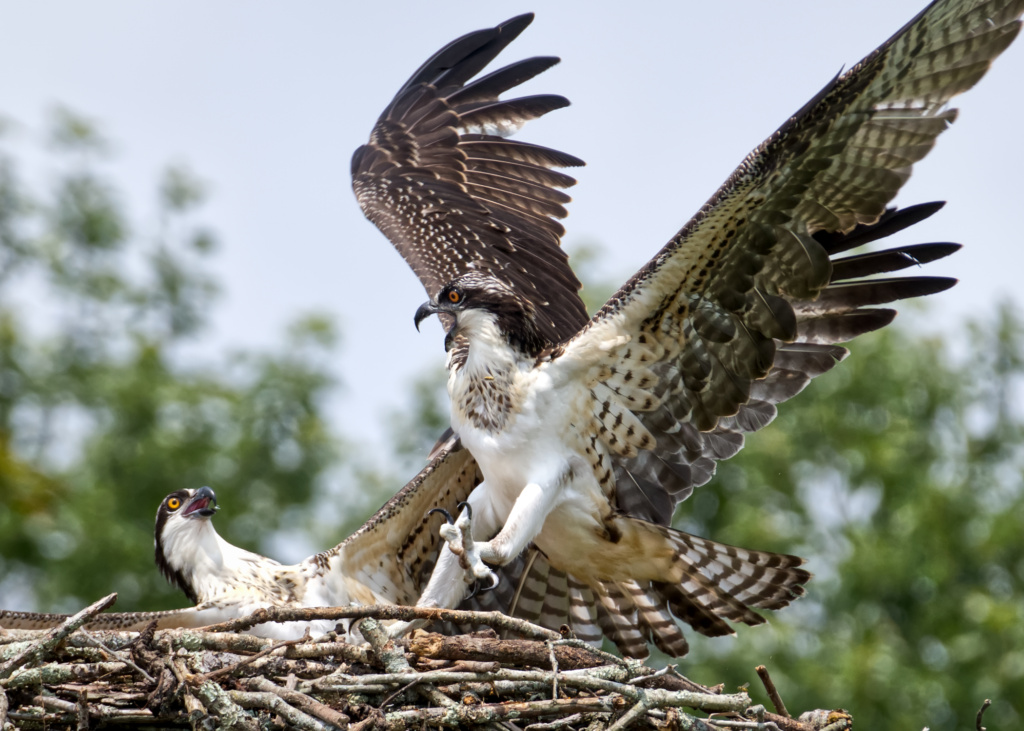
Photo by Joseph Szalay
The Atlantic States Marine Fisheries Commission also approved coastwide menhaden catch limits of 170,000 metric tons in 2027 and 155,000 metric tons in 2028 — an inadequate 9% reduction year over year for the next two years. The new coastwide limit takes effect Jan. 1, 2027, and the Chesapeake Bay cap takes effect May 1, 2027. The commission has committed to reviewing the Bay cap at least every three years.
Connecticut Audubon urges the commission to pursue additional research into menhaden availability and its effects on Osprey populations while taking stronger precautionary action to protect this critical food source. We will keep monitoring Osprey productivity under our Osprey Nation program to keep the commission informed.
We remain committed to advocating for stronger menhaden protections and thank our dedicated Osprey Nation stewards, conservation partners, and everyone who submitted public comments.
Founded in 1898, the Connecticut Audubon Society protects Connecticut’s birds, other wildlife, and their habitats through conservation, education, and advocacy. Connecticut Audubon operates nature facilities in Fairfield, Milford, Pomfret, Hampton, Sherman, and Old Lyme, a program that focuses on education in the greater Hartford area, and an EcoTravel office in Essex. It manages 22 wildlife sanctuaries, encompassing more than 3,400 acres of open space, and educates over 100,000 children and adults annually.
###
Media Contact:
Melissa Chan
203-259-0416 ext. 408