California Gull
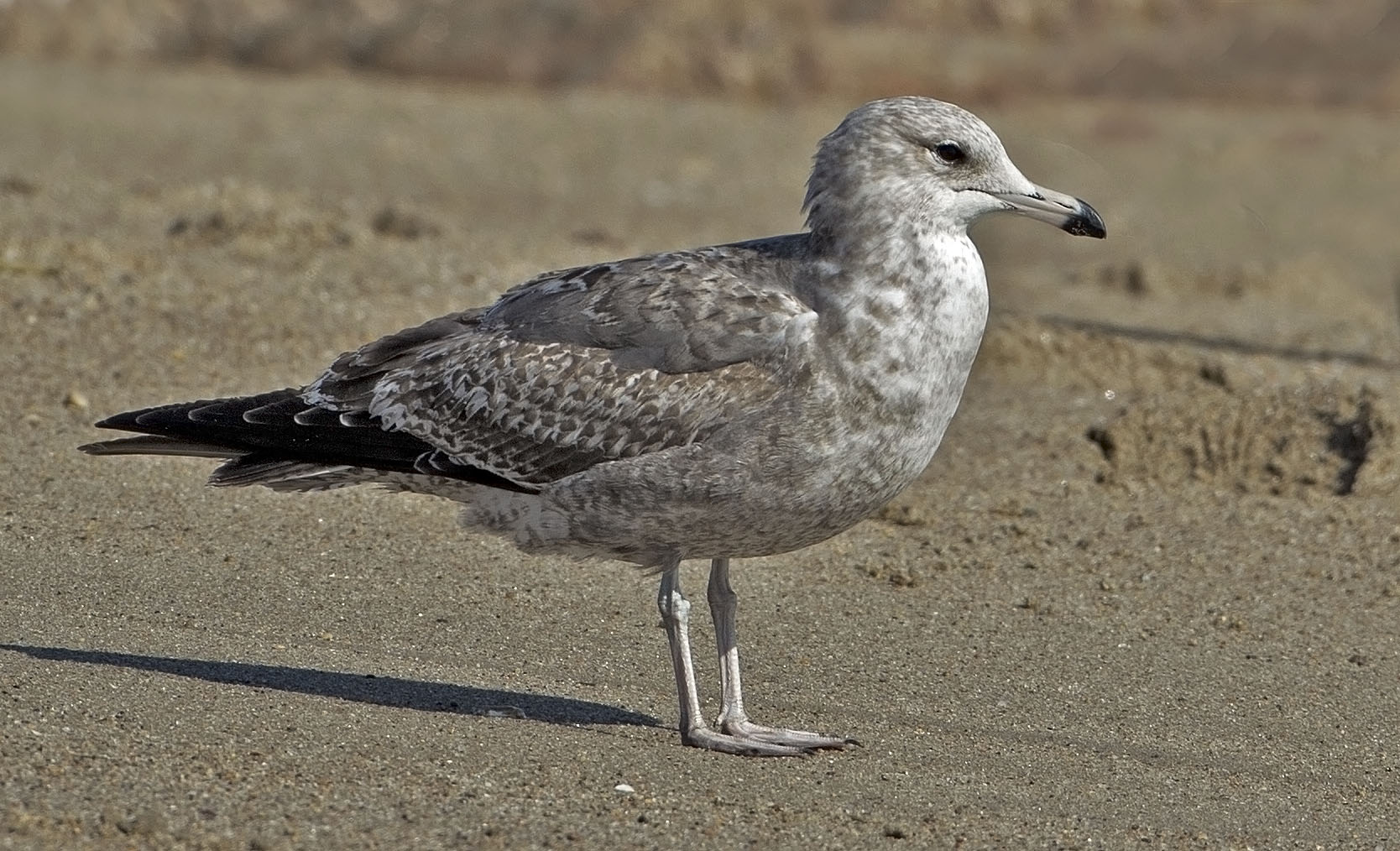
California Gull at Hammonasset. Photograph by Stefan Martin
California Gull
Larus californicus
by Greg Hanisek, editor of The Connecticut Warbler
I don’t think Stefan Martin will have a statue of himself erected at Hammonasset Beach State Park for finding Connecticut’s first California Gull on March 21, 2016, but the species he found has one erected in its honor — in Salt Lake City. The California Gull Monument recognizes Utah’s state bird for devouring hordes of Rocky Mountain crickets that threatened crops in 1848. The California Gull that Stefan was the first to see was certainly less dramatic, but it excited Connecticut birders for days.What It Looks Like: For better or for worse, it looks like a gull. This fills a dedicated minority of birders with glee and many others with dismay. Age-group differences add to the complexity of gull identification, and the California Gull present in 2016 was a first-cycle bird, one hatched during summer 2015. It is similar to brown first-cycle Herring Gulls, but it is a more rakish, long-winged bird with all dark primary flight feathers. It is intermediate in size between Herring and Ring-billed Gulls. Other features include brown eyes and a distinctive bill – relatively long and thin with a pale pinkish base and a sharply defined black tip.
How To Find It: Gulls can appear at waterways throughout the state, but in March and April substantial action centers on Long Island Sound. With the closure of all major state landfills, which were gull magnets from late fall through early spring, gull variety and volume now centers on spring staging in the Sound.
The gulls form large but very mobile flocks that surface-feed on zooplankton such as barnacle larvae. These flocks, best sought in the western and central parts of the Sound, have historically produced Little and Black-headed Gulls (along with one Ross’s Gull), associating with Bonaparte’s Gull flocks. Increasingly Ring-billed and Herring Gulls (with a few Iceland Gulls) are involved, and during the springs of 2015 and 2016 they’ve been joined by three subspecies of Mew Gulls and Thayer’s Gull as well as the California Gull. It seems that almost anything is possible.
Search for flocks feeding on the water’s surface or roosting at places such as the mouth of the Oyster River in Milford/West Haven or at Southport Beach in Fairfield. It’s wise to check the Connecticut Ornithological Association’s archives or E-Bird before heading out.
Conservation Status: Least Concern