American Goshawk
Accipter atricapillus
by Nick Bonomo
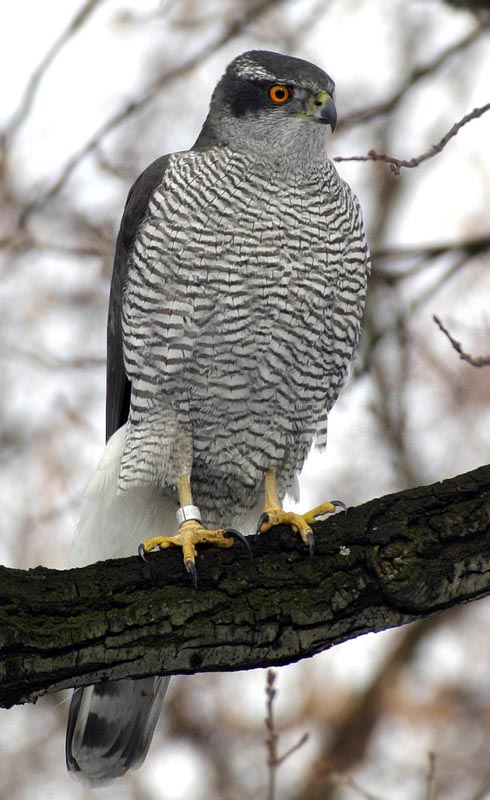
The American Goshawk is the largest member of the genus Accipiter in North America. Most closely related to the smaller Sharp-shinned Hawk, this bird combines features of the Sharp-shinned and Cooper’s Hawk (Astur cooperii, formerly Accipiter cooperii) but in a bigger, meaner package; all three are superbly built to hunt and eat smaller birds. Adult goshawks are very distinctive. Their combination of gray upperparts, white underparts that are finely barred, and a very strong white-and-dark head pattern is unique among local raptors. The largest females are as large as Red-tailed Hawks.
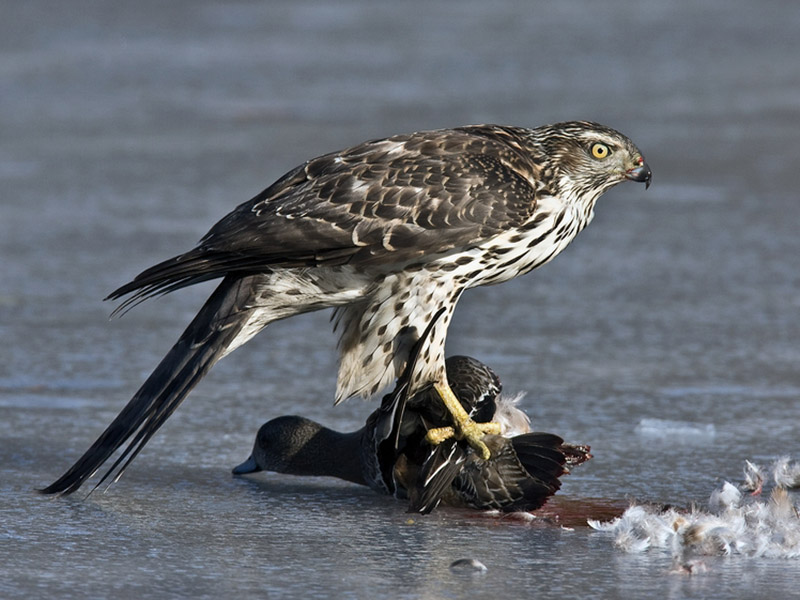
Immatures, however, pose an infamous identification problem. They appear brown and streaky like many other young hawks. Immature Cooper’s Hawks are very commonly mistaken for the much rarer American Goshawk. At this age, look for the bird’s bulky proportions; Cooper’s Hawk looks lankier and thinner-bodied than the robust goshawk. An American Goshawk’s wings have longer secondaries than a Cooper’s, which gives the wings a bulge along the trailing edge in flight while giving the impression of a broader-winged bird overall. Also note the density of the streaking below, as Goshawks are heavily streaked while Cooper’s have thinner streaks thus appear paler below.
Conservation status: Since the American Goshawk is the most widely distributed Accipiter in the world, occurring on four continents, it is consider a species “of Least Concern” by the IUCN. However, locally, the goshawk is susceptible to habitat loss via forest clearing and fragmentation. North American populations appear to be stable.
Photos from Carolinabirds.org: Norbert Kenntner, top, and Elaine R. Wilson.