Jack-in-the-Pulpit — A Botanical Drama Featuring Murderous Hermaphrodites
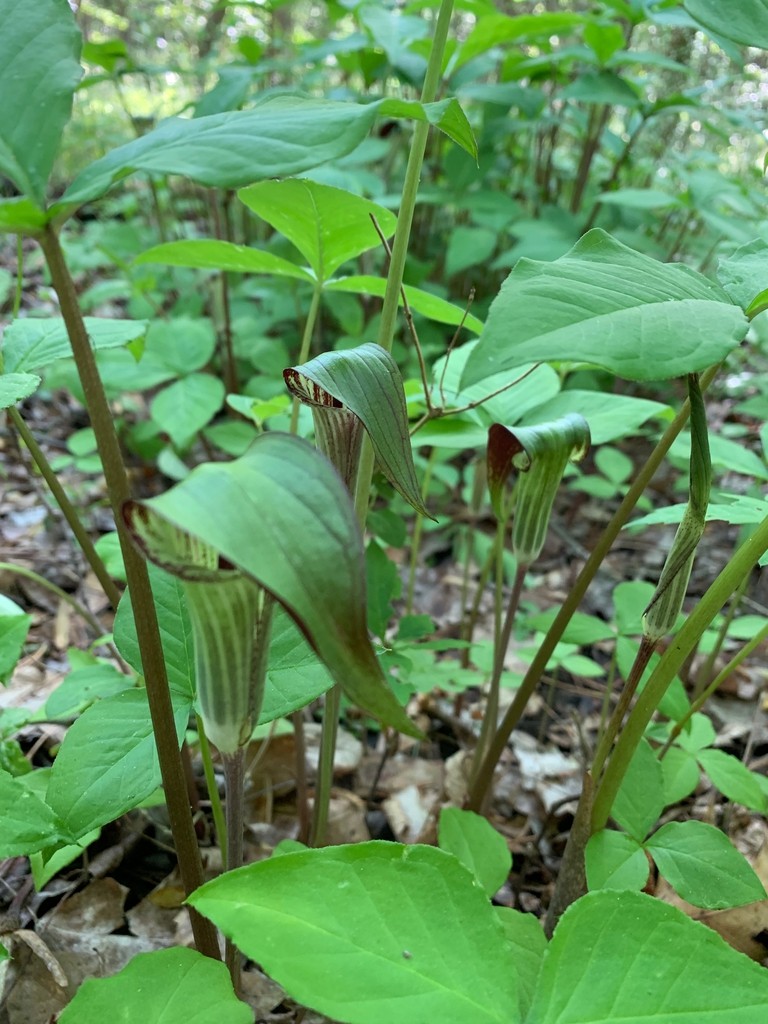
In early spring Jack-in-the-pulpit sends up stalks with a hood-like form that gracefully arches over the plant’s reproductive parts. Photo from the North Carolina Extension Gardener Plant Toolbox.
Homegrown Habitat provides information on native plants that support birds and other wildlife and can be used in cultivation. This monthly column is written by Sarah W. Middeleer, a landscape designer whose work has an ecological focus. Sarah is a member of the Connecticut Audubon Board of Directors. Write to her at homegrown@ctaudubon.org.
Jack-in-the-pulpit
Arisaema triphyllum
As you venture outside again after this snowy, cold winter, be sure to take a peek in the shady, moist areas that may not yet seem very appealing. All kinds of activity is occurring there, including – if you’re lucky – the emergence of Jack-in-the-pulpit (Arisaema triphyllum) through the soggy layer of last autumn’s fallen leaves.
This odd-looking, perennial wildflower native to the eastern U.S. can be hard to see, with its pale green and sometimes maroon markings camouflaged in dappled shade. It grows, from an underground storage organ called a corm, to between one foot and two feet tall. In early spring it sends out a stalk topped by a hood-like form (the pulpit) gracefully suspended over a deep opening. From inside this opening rises a greenish-white, candle-like form (Jack).
The botanical term for the pulpit is spathe, which is a modified leaf. There are only one or two true leaves, each with three leaflets. The botanical term for the Jack is spadix, which contains the plant’s reproductive parts.
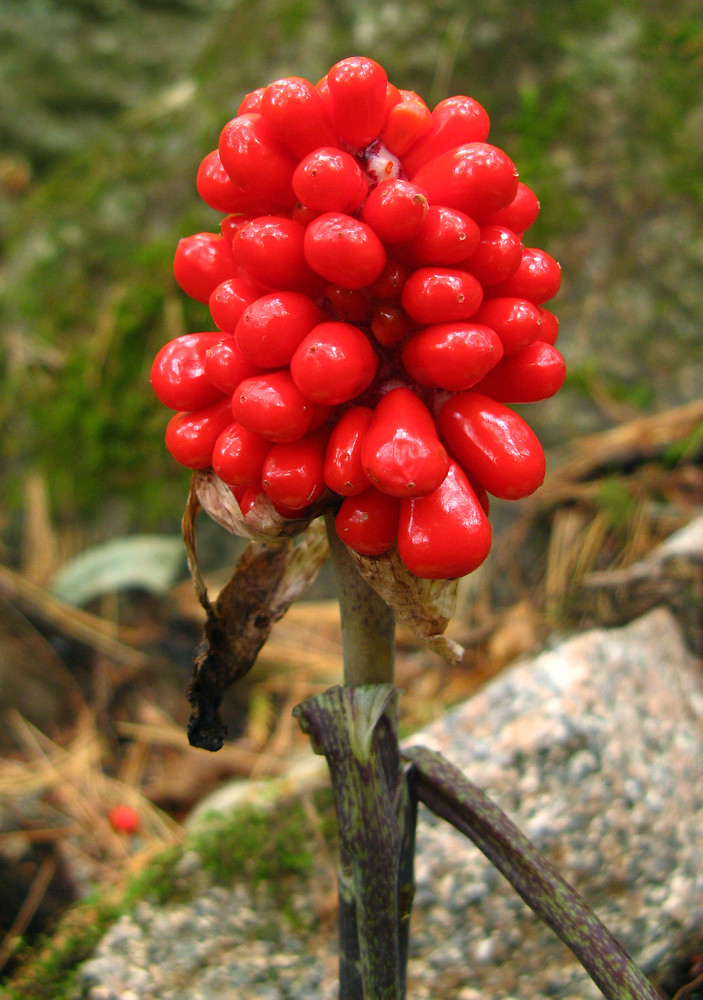
Female Jack-in-the-pulpits produce bright-red berries in mid-summer that are enjoyed by songbirds, box turtles, and small mammals.
Genetically bisexual, Jack-in-the-pulpit initially produces male flowers on the spadix and just one leaf. If they have been able to store ample nutrients, some plants become hermaphroditic as they mature, developing female flowers toward the bottom of the spadix, and a second leaf. Most of the colony will go dormant and vanish by midsummer, but the mature, female plants will produce a tight cluster of bright-red berries that may linger until fall. Once their energy resources have been depleted again, these plants may revert back to male.
Many songbirds, including Wood Thrush, as well as Wild Turkey, box turtles, and small mammals, eat the fruit. Germination of the seed is enhanced by passing through the box turtle’s gut.
Jack-in-the-pulpit produces pollen but no nectar. Although small flies and beetles sometimes pollinate this plant, fungus gnats are the primary pollinators. They are attracted by a faint fungal scent emitted by the flowers, because the gnats are looking for mushrooms on which to lay their eggs.
Unwittingly they follow the scent into the deep chamber. When the disappointed gnats try to leave, they are often thwarted by the spathe hood or its slippery interior walls. Down they go again, becoming covered in the plant’s pollen.
Male Jack-in-the-pulpit plants contain an escape hatch–a small hole at the base of the spathe–through which the gnats can finally emerge. Once free from its confines, they proceed to other plants in the colony, making the same mistake as before.
If these gnats, by now weighed down by lots of sticky pollen, should become trapped in a female Jack-in-the-pulpit, they will perish because the females have no escape hatch. But her flowers will have been pollinated by the misdirected, ill-fated creatures desperately trying to leave. It is highly unusual in co-evolution for one of the participants to receive no benefit.
Jack-in-the-pulpit has a long history of ethnobotanical uses. Native Americans used it to treat bronchitis, rheumatism, and snakebite. Also known as Indian turnip (among other colorful epithets), it was eaten after being boiled and dried. Its fruit and corms produce a sharp, bitter sensation when eaten raw–due to calcium oxalate–but once cooked they are edible.
Thankfully deer typically avoid Jack-in-the-pulpit, as do invasive European earthworms – both of whom are threats to the other lovely plants that grow in association with Jack-in-the-pulpit on the forest floor.
You’ll be much more likely to encounter Jack-in-the-pulpit in uncultivated places than in nurseries, but some mail-order nurseries do offer plugs, bare-root plants, or seeds. Growing this plant from seed is for the patient gardener, for it requires two periods of dormancy (plant the seeds in fall and they will germinate in the second spring), and seed-grown plants won’t fruit for five years. Nonetheless, Jack-in-the-pulpit is easy to grow.
Never dig plants from the wild without permission, which often fails anyway because people don’t understand the complex growing needs of such plants, nor the correct protocol for transplanting them. But should you have a moist, shady spot in your yard, you may already have Jack-in-the-pulpit there. Don’t confuse its three leaflets with those of poison ivy or trillium, which are similar. And refrain from cleaning up leaves around it in the fall, since this plant needs their winter cover. Partial, rather than heavy, shade will help to ensure fruit production.
To complement your Jack-in-the-pulpit, include ferns, false Solomon’s seal, wild bleeding heart, wild geranium, spring beauty, Dutchman’s breeches, trillium, Pennsylvania sedge, and meadow rue. The spring and early summer display of this woodland garden will delight you and your backyard birds–but alas, not the fungus gnats.
Send comments and questions to homegrown@ctaudubon.org
Resources
Books:
Carol Gracie, Spring Wildflowers of the Northeast a Natural History, Princeton University Press, 2012
Mark Richardson and Dan Jaffe, Native Plants for New England Gardens, Globe Pequot, 2018
Websites: