An 'Unmistakable Warning Sign,' Osprey Nation Sees Worst Breeding Success and More Record Lows in 2026
This is the first time the majority of nests only had a single fledgling.
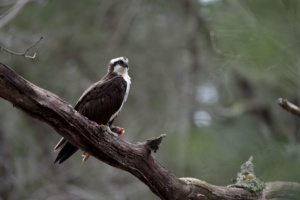 FAIRFIELD, CT — The Connecticut Audubon Society’s Osprey Nation program ended its 2026 season with its worst breeding success ever, as other troubling figures indicate for the first time that starvation may be a major factor.
With 99% of the season’s data compiled, Osprey productivity stands at 0.87 chicks per breeding pair, down sharply from the previous record low of 1.26 in 2025.
Even more discouraging, of the 407 nests that produced fledglings, about 61% produced a single fledged chick, and only 33% fledged two chicks. This marks the first time in Osprey Nation’s 13-year history that the majority of successful nests only had a single fledgling. All prior years would see the majority of successful nests fledge two chicks.
“This is an unmistakable warning sign,” said Connecticut Audubon’s Conservation Science Manager Matt Joyce. “This is probably the strongest evidence we have that there is an issue with prey provisioning.”
Connecticut Audubon is releasing its data early this year, as it races to convince the Atlantic States Marine Fisheries Commission (ASMFC) to significantly limit how much menhaden can be fished out of the Chesapeake Bay.
The ASMFC, which sets the ceiling for East Coast states on the number of fish that can be caught commercially, is seeking input from the public on a set of proposed changes until Oct. 9. It will consider final approval at its annual meeting in November.
Amid growing concern that Osprey populations along the Eastern seaboard are declining due to a lack of food, Connecticut Audubon is urging the ASMFC to reduce the fishery cap by 50%, a precautionary measure to ensure that menhaden, a key foundation fish and a prime food source for Connecticut’s Osprey, are not put in even greater jeopardy.
Even more so now, the numbers show that Osprey and other species that rely on menhaden do not have years longer to wait.
This year, Osprey Nation also saw a high number of nest failures and a severe drop in the number of nests that fledged three chicks. Of 679 total nest attempts, 40% failed. Failures include nests where incubation was unsuccessful as well as nests where chicks hatched but did not survive to fledging. Both types of failure can be associated with food stress, although weather, disturbance, predation, inexperience, and other factors can also contribute to unsuccessful nests.
Meanwhile, only 23 nests — less than 6% of all nests — fledged three chicks this year. In previous seasons, up to 20% fell into this category.
Connecticut Audubon typically spends more time reviewing, analyzing, and verifying the large Osprey Nation dataset before releasing its annual findings. This year, staff and volunteers accelerated that process because of concerns about the season’s breeding results and the approaching ASMFC public comment deadline.
About three nests still require final confirmation, and Connecticut Audubon continues to review the data closely for discrepancies or corrections. With 99% of the dataset complete, minor changes to the final figures remain possible, but Connecticut Audubon does not expect them to significantly alter the overall findings. A final analysis of the 2026 Osprey Nation data will be released later this year.
The rapid analysis would not have been possible without the extraordinary work of Osprey Nation’s roughly 450 volunteer stewards, who monitored about 1,000 current and historical nest sites and made a concerted effort to submit their observations quickly so the data could be evaluated before the ASMFC deadline.
“Our stewards’ hard work has illustrated an alarming picture and emphasizes the immediate need for precautionary action to safeguard our Ospreys’ future,” Joyce said.
There are several ways to make your voice heard. Here’s how:
Submit your comment
Until Oct. 9, you can submit your comment through the commission’s online form or survey. You can also email comments@asmfc.org — with “Menhaden Draft Addendum II” in the subject line — or mail comments to James Boyle at 1050 N. Highland St., Suite 200 A-N, Arlington, Virginia 22201.
Complete an online survey
The commission strongly encourages the use of the public comment survey as it allows users to select specific preferred options in the Draft Addendum and provides space for open-ended comments at the end. Connecticut Audubon supporters can indicate they want a 50 percent reduction in the Bay Cap, with option B2 for how the catch is distributed in amounts across time.
Please help us urge the commission to act now while remaining open to stricter measures.
Founded in 1898, the Connecticut Audubon Society protects Connecticut’s birds, other wildlife, and their habitats through conservation, education, and advocacy. Connecticut Audubon operates nature facilities in Fairfield, Milford, Pomfret, Hampton, Sherman, and Old Lyme, a program that focuses on education in the greater Hartford area, and an EcoTravel office in Essex. It manages 22 wildlife sanctuaries, encompassing more than 3,400 acres of open space, and educates over 100,000 children and adults annually.
###
Media Contact:
Melissa Chan
mchan@ctaudubon.org
203-259-0416 ext. 408