Rufous Hummingbird
Selasphorus rufus
by Andy Griswold
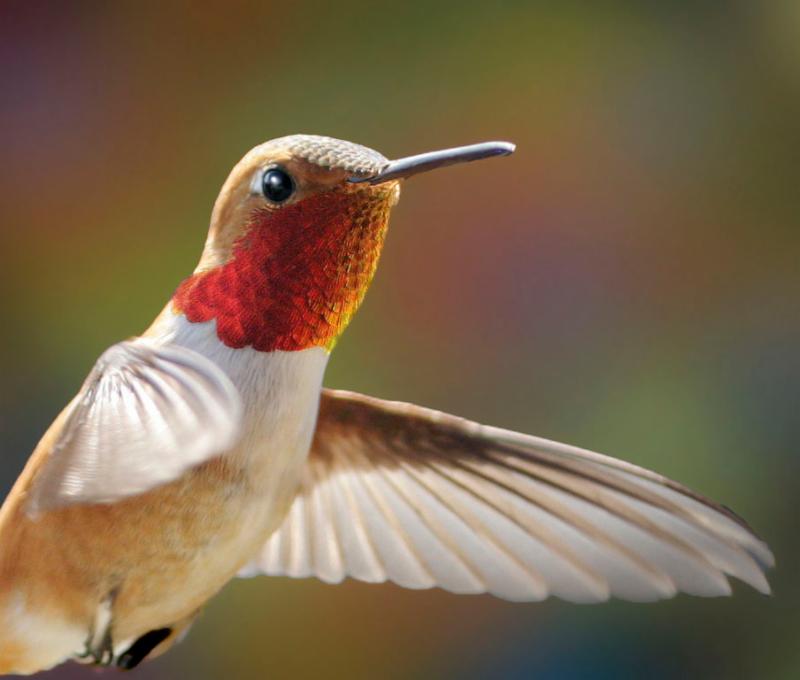
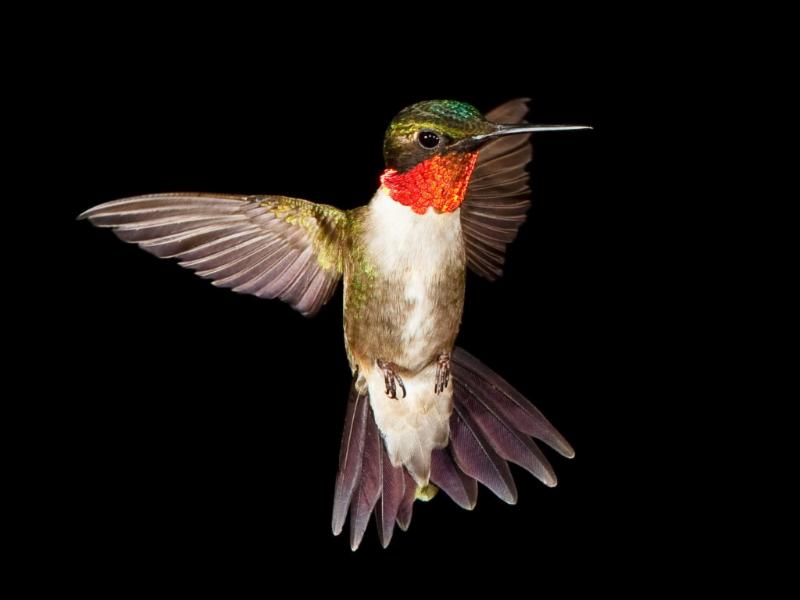
What it looks like: Measuring in at 3-3/4 inches, this short winged, compact hummingbird could, depending on the plumage, be passed over as our more common Ruby-throated Hummingbird (photo on left is Rufous; photo in center is Ruby-throated).
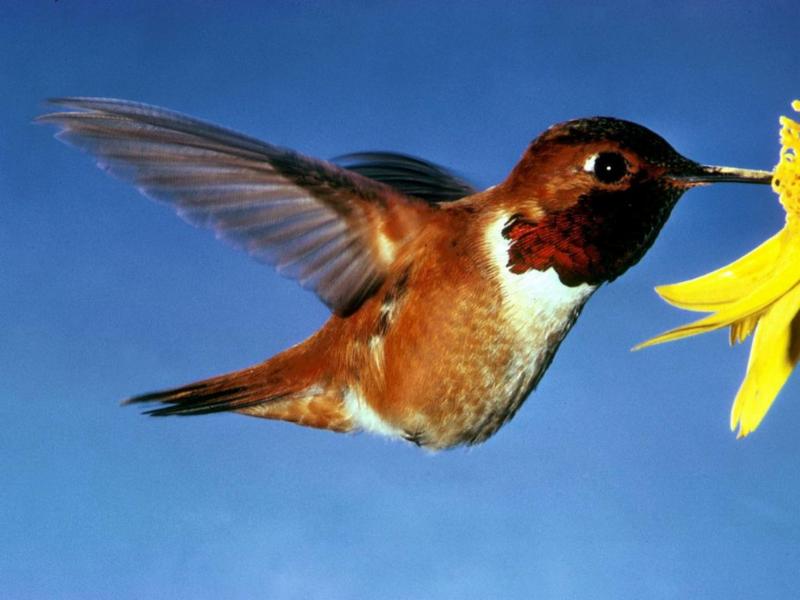
Adult males are hard to miss with their brilliant orange throat that can, in the right light, glow like embers from a fire. For females, you will want your binocular handy. Both male and female have an obvious rufous coloration at the base of their tails, which Ruby-throated does not. In all plumages, Rufous Hummingbird has a wash of buffy red to strong rufous along its sides and belly, absent in Ruby-throated.
How to find it Of course, the best place to be looking for this species is at your hummingbird feeder. As summer wears on, Rufous Hummingbird is known to disperse from its normal range and travel in significant numbers to the east coast states.
The key to attracting this species is to leave your feeders out after the Ruby-throated has left, at the end of September. Any hummingbird at your feeder after October 1 should be thoroughly scrutinized as to what species it is.
Rufous Hummingbird is very aggressive at the feeder, so look for any behavior that may be indicative.
Rufous Hummingbird makes one of the longest migratory journeys of any bird in the world, with a strait-line measurement of as much as 7,800 miles round-trip between Alaska and Mexico.
Study those Ruby-throated Hummingbirds so your mind will click right in when you see something that is not the norm. There have been records of even rarer hummingbird species in Connecticut including Calliope Hummingbird and Black-chinned Hummingbird. And there are the occasional visits to the feeder by species one might think would not use it, like Downy Woodpecker.
Conservation status This species has seen a serious decline, according to the North American Breeding Bird Survey, which tracked a 62 percent decline between 1966 and 2010. The entire population breeds in the United States and Canada and then winters in Mexico. This species is on the Red List of the International Union for the Conservation of Nature (IUCN) because of this steep decline, but because the world population is estimated at being 11 million, it is only in the category of “Least Concern.” The population decline is likely due to pesticide use.
Andy Griswold is director of Connecticut Audubon’s EcoTravel program
Photos from top to bottom:
Rich Leche
Jason Paluck (Ruby-throated)
Dean Biggins