Connecticut Audubon Urges Fisheries Commission to Limit Menhaden Harvest as Osprey Nest Failures Rise
The public has a chance to weigh in on a meaningful reduction to the Chesapeake Bay fishery cap.
The Connecticut Audubon Society on Wednesday urged the Atlantic States Marine Fisheries Commission to significantly limit how much menhaden can be fished out of the Chesapeake Bay, amid growing concern that Osprey populations along the Eastern seaboard are declining due to a lack of food.
The commission — which sets the ceiling for East Coast states on the number of fish that can be caught commercially — voted to release a draft addendum for public comment, giving Connecticut Audubon supporters and other advocates the opportunity to weigh in on a meaningful reduction to the Chesapeake Bay fishery cap.
The vote followed testimony from conservationists along the East Coast, including Connecticut Audubon’s Conservation Science Manager Matt Joyce.
“We worry that 2026 is the year Connecticut joins a growing list of states which are watching Osprey chicks starve to death en masse,” Joyce said. “This year’s data, while admittedly incomplete, is beginning to paint a grim picture.”
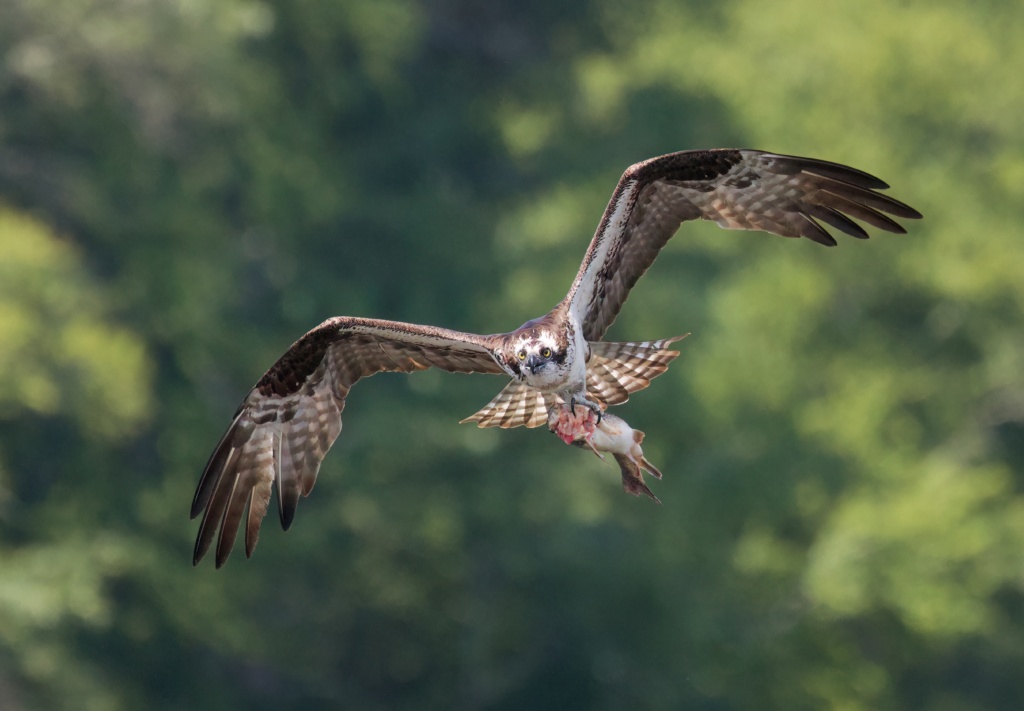
An Osprey carrying fish. Photo by Liz Jaffin
Last year, Connecticut Audubon’s Osprey Nation recorded its lowest breeding success since the statewide community science program launched in 2014.
Because Ospreys feed almost exclusively on fish, Osprey Nation serves as an early-warning system for the health of Connecticut’s waters and the abundance of prey species like Atlantic menhaden. More than 400 volunteers submit weekly reports on the breeding outcomes of about 1,000 Osprey nests across Connecticut.
By Aug. 1, 2025, out of 706 nests with up-to-date reports, 113 had failed — about 1 in 6. In the same timeframe this year, of 691 nests with up-to-date reports, 171 have failed — roughly 1 in 4.
For decades, abundant menhaden at the mouth of the Connecticut River helped sustain the largest concentration of nesting Ospreys on the Connecticut coast at Great Island in Old Lyme. As observers notice menhaden becoming increasingly scarce, Osprey reproductive success has sharply declined.
At Great Island — what was once a former Osprey stronghold — only 27 Osprey chicks fledged in 2025, which decreased from 37 in 2024. So far this year, just five chicks have fledged.
Researchers have also confirmed declines in the Chesapeake Bay and in New Jersey. On Wednesday, advocates from Virginia and Maryland warned the commission about consistently declining Osprey numbers.
“We acknowledge that there is a myriad of factors that can contribute to a species’ decline,” Joyce said. “However, there is a well-documented downward trend, occurring over multiple years, across a growing geographic area, and with strong evidence that a lack of menhaden being provisioned to chicks is responsible.”
The Atlantic States Marine Fisheries Commission’s Atlantic Menhaden Management Board voted overwhelmingly to advance the draft addendum for public comment. The public comment period, which will include public hearings, is expected to take place in September and October. The Atlantic Menhaden Management Board will consider final approval at its annual meeting in November.
Founded in 1898, the Connecticut Audubon Society protects Connecticut’s birds, other wildlife, and their habitats through conservation, education, and advocacy. Connecticut Audubon operates nature facilities in Fairfield, Milford, Pomfret, Hampton, Sherman, and Old Lyme, a program that focuses on education in the greater Hartford area, and an EcoTravel office in Essex. It manages 22 wildlife sanctuaries, encompassing more than 3,400 acres of open space, and educates over 100,000 children and adults annually.
###
Media Contact:
Melissa Chan
mchan@ctaudubon.org
203-259-0416 ext. 408