CT is an example for how to save Purple Martins
Linda Miller – Purple Martins
Robert Miller 7/1/2023 – Danbury News Times / CT insider etc.
Hope is the thing with feathers,
And, Ms. Dickinson, it is the thing with fingers and brains and the perseverance to get a fix on those feathered things — in this case, purple martins — and help them to increase, spitfiring across the sky.
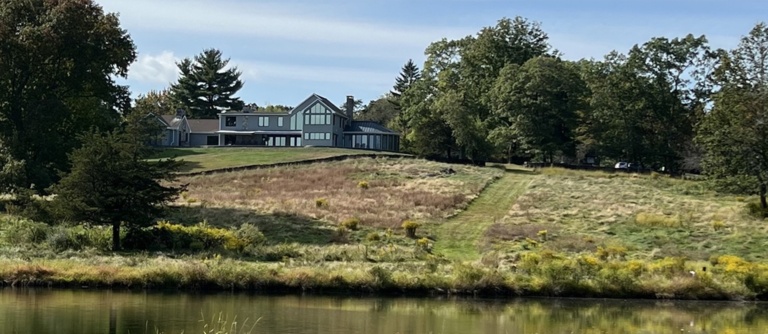
It is that hope that brought the staff of the Sharon Audubon Center, students from Marvelwood School in Kent and a leader of the Purple Martin Conservation Association to the Emily Winthrop Miles Audubon Sanctuary in Sharon last month to capture purple martins as they flew into their man-made colony there.
Once caught, the team weighed and measured each bird, checked their health, then flitted them with little bird backpacks. The tracking devices on those backpacks will help researchers follow their coming and goings around western Connecticut, down to their wintering grounds in Brazil, then back north in the spring.
It’s because of work like this throughout the state — setting up purple martin houses, and monitoring the birds that nest in them — that sets Connecticut apart from the rest of New England. Once listed as a threatened species in the state, they’ve been upgraded to a Species of Special Concern. There are more purple martins here than there used to be.
“It’s an idea that’s been long in the making,’’ said Brian Hess a wildlife biologist with the state Department of Energy and Environmental Protection.
The work is done under a federally-authorized Bird Banding Permit issued by the US Geological Survey and a state permit issued by DEEP.
“Connecticut is a shining example of what can be done,’’ said Joe Siegrist, president of the Pennsylvania-based Purple Martin Conservation Association. ‘In the other New England states, they’re gone.’’
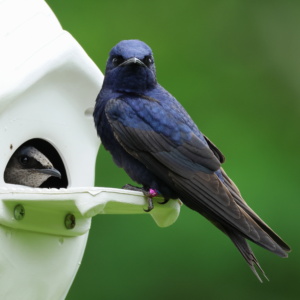
Purple martins need our help. In the eastern United States, they live almost exclusively in man-made house. (West of the Mississippi River, the birds do things the old-fashioned way, nesting in tree cavities.)
They are the largest member of the swallow family and like their cousins, they are fleet, artful flyers. The males are blue-black-purple, all over. The females and juvenile males are dark on top, paler underneath.
They are insectivores, catching their food on the wing, eating insects as large as dragonflies. They thrive in open spaces near bodies of water — swamps, marshes, lakes.
Native Americans, seeing their insect-eating value, hung empty gourds in their villages to entice purple martins to live nearby. European colonists did the same. Today, however, the purple martin mini-mansions of old have given way to clusters of plastic gourd-shaped condos.
They’re vitally important. Purple Martins, like many insect-eating birds, are in decline.
Siegrist said researchers are trying to learn why this is happening “It could be habitat loss,’’ he said. ‘It could be due to the loss of insects and we don’t know all the factors contributing to that. It could be pesticides. It could be climate change.’’
To study purple martins, you first need the birds. There are several colonies along the Long Island Sound coastline.
But Laurie Doss, chairman of Marvelwood School’s science department, said the number of people keeping purple martin houses elsewhere had been in decline. “By 2011, there are only three colonies in inland Connecticut,’’ she said.
Through her efforts and through the work of groups like the Kent Land Trust, Audubon Connecticut and the Connecticut Audubon Society, there are now 13 colonies in western Connecticut. “We’re hoping to have more,’’ she said.
The Miles Sanctuary is managed by the Sharon Audubon Center, part of Audubon Connecticut. Eileen Fielding, the center’s director, said working with the Doss and the Marvelwood School students was a natural fit.
“As an Audubon center, we’re involved with conservation projects,’’ she said. “Anytime we can join with local organizations, that’s great.’’ She said.
There are several colonies along the Long Island Sound coastline.
Some of the birds captured at the Miles Sanctuary were fitted with tiny GPS recorder. In a year, if Doss and her students recapture any of these birds, the GPS recorders will has stored data about the all the birds’ travels.
Others were fitted with Motus trackers. The Motus Wildlife Tracking System in an international effort to use radio signals to track any birds, bats and insects that pass by a Motus receiving tower. That gives researchers real-time information about their movements.
There are now Motus towers at the Sharon Audubon Center, the Deer Pond Nature Center owned by the Connecticut Audubon Society in Sherman and at Marvelwood School in Kent.
The DEEP’s Hess said all this information will help them understand more about purple martins, and the state’s biodiversity in general
“Birds are complex,’’ he said. “Ecosystems are complex.’’