Hairy Woodpecker
Picoides villosus
by Michael Aurelia, former member of the Connecticut Audubon Society’s Board of Directors
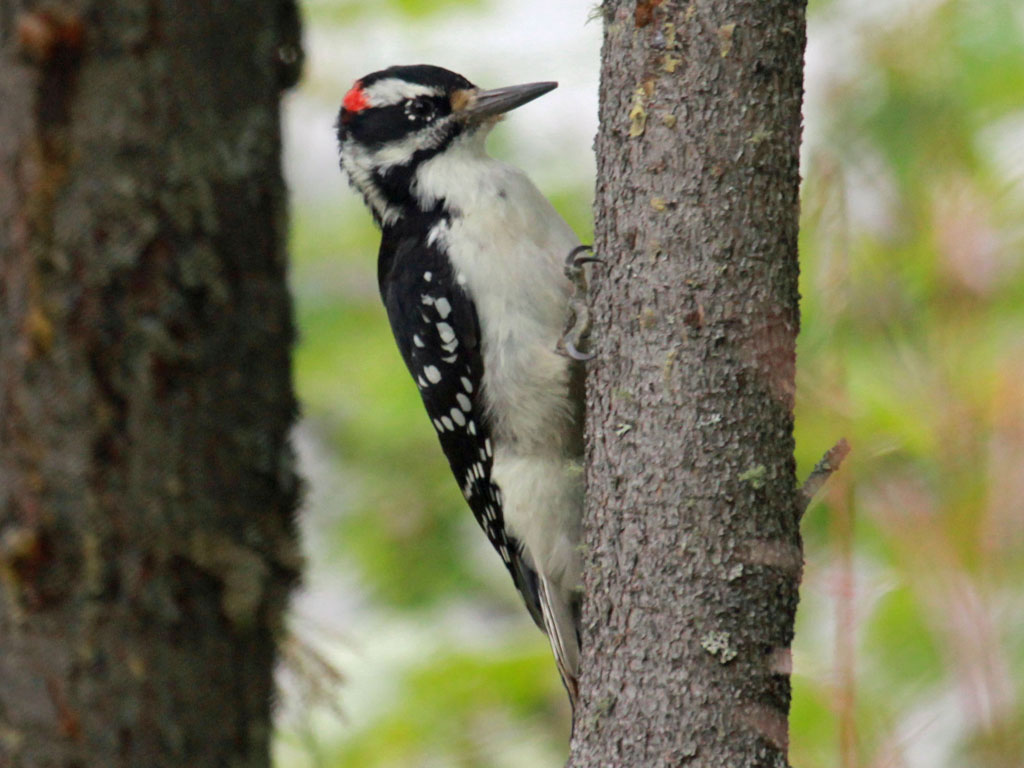
The Hairy Woodpecker is the “larger cousin” of the Downy Woodpecker. Like the Downy, it is one of the most familiar and widespread woodpeckers in North America.
According to Cornell’s online “The Birds of the World,” the Hairy Woodpecker gets its name from a series of long, filamentous white feathers in the middle of its back. Both female and males are largely white and black, with the male having a red patch at the back of its head. The Hairy and Downy Woodpeckers are the only one with a large white patch in the middle of their back.
All woodpeckers have stiff tails and chisel-like bills to facilitate their intimate association with trees. Like most other woodpeckers, the Hairy flies in a deeply undulating path across the sky.
Where and How to Find It: Almost any time of the year this woodpecker is found in forested habitats. It likes more mature trees with numerous dead limbs. Unlike the Downy Woodpecker, the Hairy rarely forages on small twigs or weed stalks. In Connecticut the Hairy is less likely to be seen than are Downy Woodpeckers.
If you feed birds in your back yard you can attract woodpeckers by putting out suet blocks although they will also visit feeders filled with sunflower seeds too.
Hairy Woodpeckers nest in tree cavities. According to Birds of North America, nests are most often placed in living trees with fungal heart rot. The female probably selects the cavity site and does most of the work. Nest excavation can take one to three weeks. Both the male and female incubate the eggs. A typical nest holds four eggs that are white in color and usually hatch in 11 to 12 days.
The Hairy Woodpecker is largely a resident species but individuals can move around regionally.