Northern Bush Honeysuckle — A Small Shrub With Big Benefits
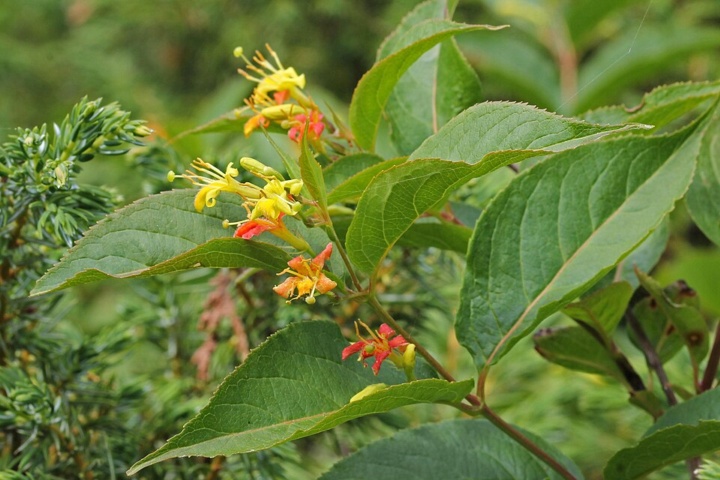
The yellow flowers of northern bush honeysuckle turn shades of orange once they are pollinated.
The uncommon northern bush honeysuckle (Diervilla lonicera) makes a wonderful addition to the native plant garden. Its list of advantages is long: small size, long bloom period, colorful foliage, low maintenance, drought tolerance, and attraction to a wide variety of insects and birds.
Don’t confuse the name with the invasive Asian bush honeysuckles. Diervilla is not a true honeysuckle. It was given the name because its flowers contain sweet nectar in tubular parts, similar to honeysuckles.
Northern bush honeysuckle grows quickly into an attractive, mounding shrub that is 3 to 4 feet tall and wide, occasionally reaching 5 feet. Its dense branching structure provides excellent cover for birds, particularly when the shrubs are massed. Killdeer and American Woodcock may nest at its base.
The leaves emerge with reddish tints before maturing to bright green, and they turn yellow, red, orange, or purple in the fall. Although deer are known to browse on northern bush honeysuckle in the wild, they do not seem to favor it in the garden setting.
Bush honeysuckle is a larval host plant for several moth species, including the snowberry clearwing, diervilla clearwing, and laurel sphinx. Their larvae are an important food source for baby birds.
Bell-shaped, yellow flowers appear from June through July, with intermittent bloom possible through August. The blossoms attract hummingbirds, butterflies, hummingbird moths, and native bees. Bumblebees are an especially important pollinator of bush honeysuckle. Once pollinated, the flowers turn peach, salmon, and red.
To produce fruit, the plants must be pollinated by insects that have visited other, genetically unique plants. The resulting seeds will feed songbirds in the fall and winter. Therefore, for fruit production, plant two or more shrubs obtained from different sources.
The northern bush honeysuckle is easy to grow from gathered seed. Sow in the fall when the capsules dry and turn dark brown, or store in the refrigerator until spring.
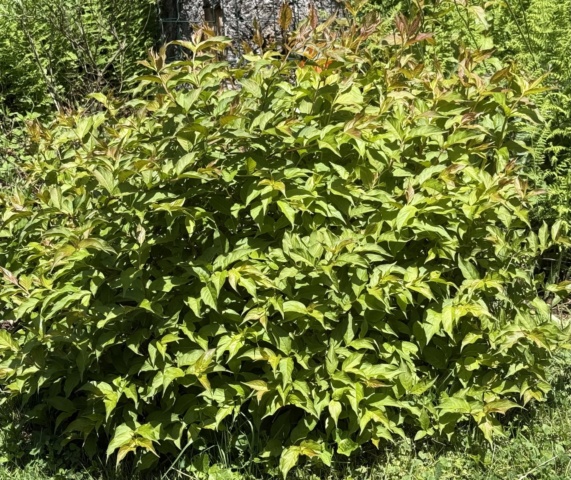
Northern bush honeysuckle grows quickly into an attractive, mounding shrub.
The plant self-propagates from both underground rhizomes and above-ground stolons that extend from the mother plant to create a colony. The spreading can be controlled, if desired, by cutting out suckers. However, its colonizing nature makes northern bush honeysuckle an excellent shrub for avian habitat, as well as erosion control and ground cover.
Northern bush honeysuckle is native to much of Canada and the eastern U.S., as far west as Iowa and Kentucky. It is at home in edge habitats and disturbed sites, growing naturally in dry, open woodlands, talus slopes, grasslands, and forest edges, where soils are well drained and infertile.
In the garden, northern bush honeysuckle prefers medium to dry soils in full sun to partial shade but is highly adaptable to various conditions. It is well suited to massing in shrub borders, low hedges, and steep slopes, as well as hummingbird, butterfly, and woodland gardens.
Depending on light conditions, natural companion plants include blueberries, serviceberry, pagoda dogwood, pin cherry, paper birch, common witch hazel, ironwood, basswood, zig-zag goldenrod, large-leaved aster, wintergreen, and early meadow-rue.
Northern bush honeysuckle makes a good substitute for Asian honeysuckle shrubs. It also can be used in place of the smaller Asian spireas and deutzias, due to its similar growth habit and flowering time. Yet it provides far greater benefits for birds, pollinators, and other wildlife.
Each month, Homegrown Habitat features a native plant that supports birds and beneficial insects and is suitable for residential gardens. This column is written by Sarah W. Middeleer, a landscape designer and member of the Connecticut Audubon Society’s Board of Directors.
Do you have favorite native plants in your garden or questions about native plant gardening? Email homegrown@ctaudubon.org with questions or observations.
Resources:
Native Gardens of Blue Hill (Maine)
University of Minnesota Extension