Virgin’s Bower — A Vine with Bedhead Seedheads
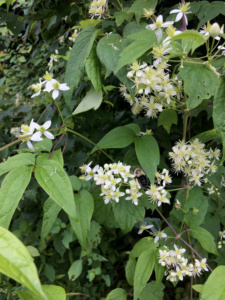
Virgin’s Bower (Clematis virginiana) Sonnia Hill, CC BY 2.0, via Wikimedia Commons
Despite its old-fashioned name, virgin’s bower (Clematis virginiana) is a marvelous plant for the modern native-plant garden. Also known as woodbine, devil’s darning needles, and old man’s beard, this perennial vine produces cascades of fragrant, white flowers from July to September, attracting pollinators and lending a romantic effect to the late-summer garden when grown on a trellis or arbor.
The lacy flowers of female plants develop into soft, silvery seedheads resembling tousled white hair. Within the seedheads are feather-like structures, called achenes, that each hold a single seed. If birds leave them untouched, the seedheads persist into winter and are said to be beautiful dusted with snow.
Late-season flowers are an important resource for insects prior to winter. Among the many native bees drawn to virgin’s bower are bumble bees, sweat bees, mining bees, and leafcutter bees. The flowers also attract hummingbirds, butterflies, moths, beneficial wasps, hoverflies, and beetles.
Virgin’s bower is also a host plant to at least 10 moth species, including the clematis clearwing moth. Their larvae are a critical food source for birds and their nestlings.
Goldfinches, indigo buntings, vireos, and wrens shelter and nest within the dense growth of virgin’s bower. Goldfinches, late-season nesters, use the feathery seed structures to line their nests. Many birds eat the clematis seeds.
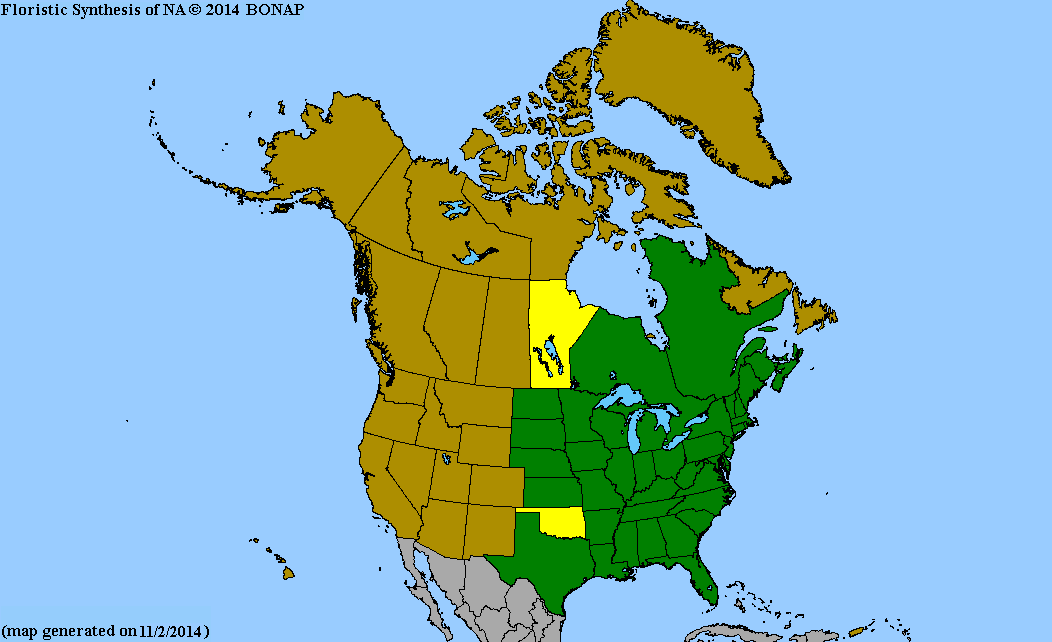
Virgin’s bower is native to much of Canada and the United States, from Quebec to Florida and west to Manitoba, the Great Plains, and Texas. It favors forest edges, disturbed areas, and fields transitioning to woodland. It is also found along watercourses and in open woodlands.
Virgin’s bower grows in full sun, partial shade, or full shade — even blooming well in shade. Although it tolerates a variety of soil types, this vine benefits from plenty of organic content and consistent soil moisture. However, it is relatively drought tolerant once established. Like all clematis species, virgin’s bower prefers to have its roots in the shade and its upper parts in full sun.
This vine is a vigorous grower, quickly reaching a height of at least 20 feet or scrambling over the ground as a dense groundcover. It will also climb up shrubs and trees. To keep it smaller, virgin’s bower can be cut back to about a foot high in late winter.
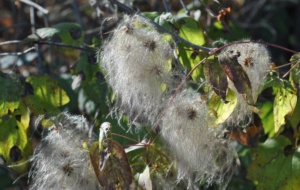
“Virgin’s Bower (Clematis virginiana)” by aarongunnar is licensed under CC BY-SA 2.0
The authors of Native Plants for New England Gardens suggest allowing virgin’s bower to climb up winterberry holly, where its seedheads will combine strikingly with the holly’s scarlet fruit.
Virgin’s bower is well suited to growing on a fence or garden obelisk, particularly in a location where you can enjoy its fragrance. Because this vine attaches to supports by twisting its leaf stems, called petioles, around them, trellises should have components less than 2 inches wide.
A large structure could potentially accommodate both an earlier-flowering native vine, such as trumpet honeysuckle, with virgin’s bower, which would provide flowers and other valuable wildlife resources from late spring through late autumn. Growing more than one virgin’s bower vine will help to ensure seedhead production.
This plant is reportedly deer and rabbit resistant as well as tolerant of juglone, a chemical produced by black walnut trees.
Virgin’s bower is often confused with sweet autumn clematis (Clematis paniculata), a non-native vine that also blooms late in the season and has somewhat similar white flowers. Unlike virgin’s bower, which has toothed leaves, sweet autumn clematis has leathery, smooth-edged leaves and is more aggressive and even invasive in some areas.
Each month, Homegrown Habitat features a native plant that supports birds and beneficial insects and is suitable for residential gardens. This column is written by Sarah W. Middeleer, a landscape designer and member of the Connecticut Audubon Society’s Board of Directors.
Do you have favorite native plants in your garden or questions about native plant gardening? Email homegrown@ctaudubon.org with questions or observations.
Resources:
Books:
Uli Lorimer, The Northeast Native Plant Primer 235 Plants for an Earth-Friendly Garden, Native Plant Trust, 2022
Mark Richardson and Dan Jaffe, Native Plants for New England Gardens, Globe Pequot, 2018
Websites:
The Biota of North America Program (BONAP)
Missouri Botanical Garden Plant Finder
National Wildlife Federation Native Plant Finder